Screen Time, Social Media & Mental Health: What the Research Says
Amidst discussing relevant topics about our society and impacts on mental health it would be impossible to ignore the impact technology has on our lives. So much of our lives, especially for younger generations, is spent on a screen. In fact, the average daily screen time for children ages 8-12 in the U.S. is 4-6 hours/day[1] and of teenagers in the U.S. (ages 13-17) is 8 hours and 39 minutes[2]. To be clear, this is screen time outside of work or educational use. Globally, 4.5 billion people use social media and the average daily social media use in the U.S. in 2022 was 151 minutes[3] which equates to >900 hours/year! The average person spends 2-4 hours/day just scrolling on their phone and touches their phone an average of 2,600 times[4].
We spend so much time on our screens because it is rewarding – but like many things that activate the reward/pleasure pathways in our brain, these behaviors can become maladaptive and cause harm. Dopamine is the neurotransmitter associated with this pleasure/reward/addictive pathway in the brain and activities or substances that cause a spiked increase in Dopamine are known as High Dopamine Activities. Conversely, activities that cause a less pronounced, more steady release of Dopamine, are known as Low Dopamine Activities.
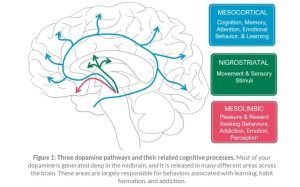
Figure 1. Haynes, T. Dopamine, smartphones & you: a battle for your time. Science in the News Boston. Accessed February 9th, 2024. (https://sitn.hms.harvard.edu/flash/2018/dopamine-smartphones-battle-time/)
Ultimately, High Dopamine Activities are Dopamine Disruptors – because of the habit-forming nature of wanting more of these Dopamine rushes and the subsequent perceived deficit when the stimulus is taken away or ends with the desire to experience the Dopamine rush again[5] – there are long-term consequences from repeated use of High Dopamine Activities that negatively impact mood, anxiety, executive functioning and even our physical health . We most commonly think of substances as being addictive and impacting us this way – nicotine, alcohol, prescription stimulants, cocaine, meth, heroin and other opiates – but also activities like gambling and pornography are included. Add screen time to the Dopamine Disruptor mix with hours of endless doom scrolling, looking at text messages, notifications, social media, gaming or anything else that is on a screen.
When thinking specifically about the developing population of children and adolescents, there are even more negative consequences of over-digitalization of their lives. Research suggests that the increased time spent indoors with less exposure to natural daylight environments during childhood and adolescents triggers a chain of connected, negative physiological repercussions with long-term effects – including but not limited to: deregulation of brain mechanisms ensuring far vision, childhood obesity, low Vitamin D levels, and dysregulation of neural circuity especially in regards to Serotonin and Dopamine[6]. There has been a dramatic rise in myopia, especially in children, around the globe which serves as a warning signal. Screen media exposure is deemed a well-documented cause of obesity in children which this article referenced previously highlights. There are also negative impacts on sleep – typically a delayed bedtime due to evening screen time – which is associated with impaired learning, poorer academic performance and psychological problems. One of the worst possible maladaptive outcomes of exposure to excessive screen time in youth is the formation of an addiction disorder. This graph below highlights the complexities of the interactions that contribute to negative outcomes:
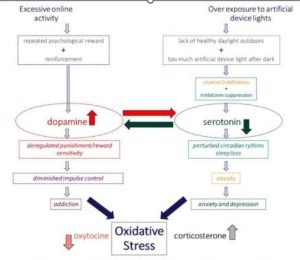
Figure 2. Pathway of how excessive online activity and over-exposure to artificial lights dysregulates Serotonin and Dopamine pathways and increases oxidative stress. Dresp-Langley, B. Children’s health in the digital age. International Journal of Environmental Research and Public Health. 2020; 17(9):3240. (https://www.ncbi.nlm.nih.gov/pmc/articles/PMC7246471/)
How much screen time is too much? There is the Displacement Hypothesis which argues that the more exposure to technology, the greater the negative impact because it displaces time spent on healthier activities, such as physical exercise[7]. The Goldilocks Hypothesis argues however that moderate use of screen time can promote well-being, whereas both limited and excessive use can negatively impact well-being[8]:
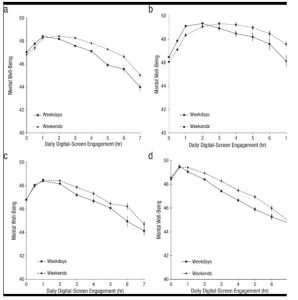
Figure 3. Mental well-being as a function of daily digital screen time on weekdays and weekends. Results are shown separately for a) watching TV and movies b) playing video games c) using computers d) using smartphones. Note that screen time is considered to be screen time for personal use, not for work or school. Przybylski et al. A large scale test of the goldilocks hypothesis: quantifying the relations between digital screen use and the mental well-being of adolescents. Psychological Science. 2017; 28(2):204-215. (https://journals.sagepub.com/doi/full/10.1177/0956797616678438)
Now let’s dive into social media in particular, the form of screen time that is often used for entertainment and comes with additional downstream negative effects when used in excess. Social media started in the 1990s:
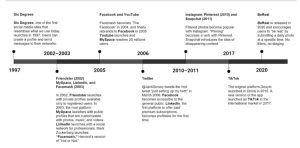
Figure 4. Johansen, S. Social media and mental health: impacts and implications for clinical practice. Powerpoint presented at Psych Congress in September 2023; Nashville, TN.
Social media use really took off in the 2000s:
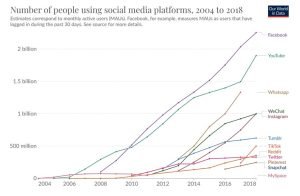
Figure 5. The rise of social media from 2004-2018. Esteban, O. The rise of social media. Our World in Data. September 18, 2019. Accessed February 10th, 2024. https://ourworldindata.org/rise-of-social-media[9]
Many things in life are complex and include pros and cons and there are some benefits associated with social media, along with harms:
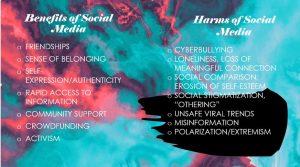
Evidence for positive impact is, however, mixed in many studies. Problems with the studies conducted so far include small sample sizes, difficult to define control conditions, many different outcomes and limited access to online, in-platform data as most data is by self-report.
How does social media work? Social media’s main goal is to keep you engaged and it does so by various ways:
The Social Dilemma on Netflix (Directed by Jeff Orlowski. Performances by Skyler Gisondo, Kara Hayward, Vincent Kartheiser, Netflix, 2020) explores this in detail and I encourage you to watch this. Essentially, there are algorithms that learn your preferences based on how you engage with the content. You do not have to communicate directly with the platform to express what your preferences are, but you can give direct feedback of what you want to see more or less of[10].
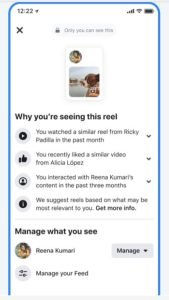
Figure 6. New ways to customize your Facebook feed. Meta: Facebook newsroom. October 5, 2022. Accessed January 14th, 2024. https://about.fb.com/news/2022/10/new-ways-to-customize-your-facebook-feed/
Social media also works to influence us by keeping us engaged by using intermittent variable rewards (likes, clicks). When rewards are not constant but intermittent this is particularly reinforcing in the Dopamine pleasure/reward pathways in the brain which heightens the experience and makes it more engaging – kind of like slot machines at the casino.

B.F. Skinner discovered this in the 1930s in his experiments with mice. The mice responded most frequently to reward-associated stimuli when they could not predict when they would be rewarded. This led to habitual checking and it is the same with humans, and current studies continue to affirm the Pavlovian reward response B.F. Skinner spoke about decades ago[11].
Another aspect of social media that makes these platforms especially engaging are the use of short content segments which make the user more likely to watch the entire clip, comment or share it, and watch it again.
So when does our social media use cross the line between engagement and pathology? Between frequent time spent enjoying something and addiction? As far as addiction goes, there is no official diagnosis in the world of psychiatric medicine for Social media addiction – but most conditions in psychiatry including recognized addiction disorders cross a threshold into pathology when there is clinically significant impairment or distress.
Let’s examine the subtypes of problematic social media use:
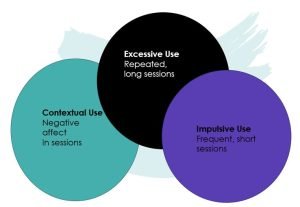
When use is problematic it is impacting our lives in negative ways. 2 potential downstream effects from frequent social media use are impaired attention and impaired sleep.
The percent of children with parent-reported ADHD diagnosis has been steadily on the rise since the advent of social media and there is one study looking at whether social media use causes attention deficits as 10 LA County High Schools with a cohort of 2,000 High School students followed for 2 years. The kids in the study did not have ADHD symptoms at baseline and were asked to report how many digital media activities they used at a high rate and the most commonly reported activity used was social media. As you can see from the graph below the kids that reported higher digital media use reported more attention deficits:
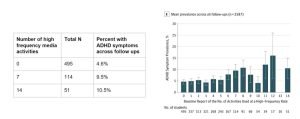
Figure 7. Association of digital media use with subsequent ADHD symptoms in youth. Cited above.
This study suggests a small but significant association between digital media use and ADHD symptoms and we need more research to clarify these questions.
In regards to sleep, studies show that as teens report more use of electronic devices, they get less sleep (Twenge JM, et al. Decreases in self-reported sleep duration among U.S. adolescents 2009-2015 and association with new media screen time. Sleep Med. 2017; 39:47-53).
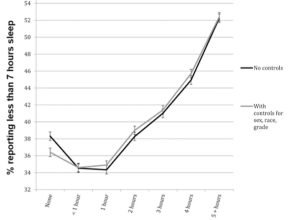
Figure 8. Graph of daily reported electronic device use and hours of sleep in teens. Twenge JM, et al. Decreases in self-reported sleep duration among U.S. adolescents 2009-2015 and association with new media screen time. Sleep Med. 2017;39:47-53. https://pubmed.ncbi.nlm.nih.gov/29157587/
During this same time according to the study, reports of sleeping less have increased along with social media use and reading the news on the internet while watching TV, homework and working a paid job have stayed the same or decreased during the same period of time.
Beyond attention and sleep there are more detrimental impacts. Remember how social media keeps us engaged with recommender systems, intermittent variable rewards and short content segments? All of these approaches result in High Dopamine in the brain’s reward pathways that over time lead to Dopamine deficits where the rewards do not feel as intense, last as long and can cause things that would normally bring us pleasure seem less enjoyable. This can lead to a loss of agency as we are drawn into these addictive activities we can slowly lose our ability to be mindful about how we spend our time and be self-determining[12].
How does social media shape our sense of self? Because of the nature of social media being powered by user-generated content there is the issue of social comparisons which is now happening on an unprecedented scale. Social comparisons can be horizontal, upward and downward. Upward social comparisons tend to make us feel worse about ourself as we are comparing ourselves to people we perceive to be better off than we are.

Contributing to the social comparison effect are filters that make people look much more glamorous or beautified or different in some perceived positive way such that people are comparing their normal self to someone else’s idealized self. Check out this example of a popular filter used on Tik Tok:

Figure 9. Example of applying Tik Tok bold glamour. ‘I wish I did look like this: see user reactions to viral, new beauty filter. CNN Business. Accessed February 10th, 2024.
https://www.cnn.com/videos/business/2023/03/07/bold-glamour-tiktok-orig-contd-fj.cnn-business[13]
In addition to filtered photos we see curated profiles. Users decide what elements to put on their social media profile which can lead people to create a false version of themselves online that is disconnected from reality.
So what is the mental health impact of heightened upward social comparisons from social media?: poor body satisfaction, low self-esteem, depressed mood, self-harm and suicide.
Facebook users show higher rates of poor body satisfaction vs. non-users in this study that is highlighted:
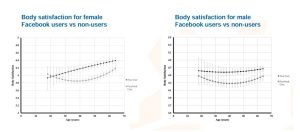
Figure 10. Graph of body satisfaction for Facebook users vs. non-users[14]. Strong S., et al. Facebook is linked to body dissatisfaction: comparing users to non-users. Sex Roles. 2015;(73): 200-213. (https://link.springer.com/article/10.1007/s11199-015-0517-6)
Instagram conducted its own research and their annotated research desk is available online. Instagram found for e.g. that Instagram makes 1 in 5 teens feel worse about themselves:
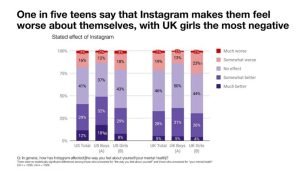
Figure 11. Teens report how Instagram makes them feel[15]
Recent data released by the CDC that surveyed teens from 2011-2021 found that 57% of females in 2021 compared to 36% in 2011 have experienced persistent sadness or hopelessness in the past year and 30% of females have considered attempting suicide in the past year. The skyrocketing rates of social media adoption from 2010-2020 tracks with these outcomes:
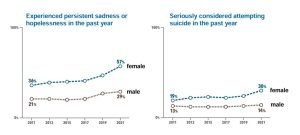
Figure 12. CDC Youth Risk Behavior Survey results 2011-2021[16] (Source cited below)
There have been dramatic increases in the self-harm rates as evidenced by this study looking at ED visits for girls aged 10-14 presenting to the ED due to self-harm from 2009-2015:
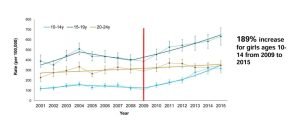
Figure 13. Graph showing rise in self-harm rates of girls ages 10-14 from 2009-2015.[17]
There has also been a 300% increase in suicide rates for girls ages 10-14 from 1999-2018:
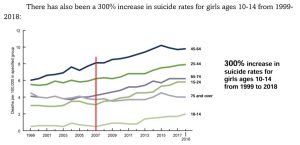
Figure 14. Rise in suicide rates for girls ages 10-14 from 1999-2018[18]
There is also the very real issue of cyberbullying which has been experienced by nearly 50% or half of teens. Cyberbullying experienced by adolescents doubles the risk for self-harm, suicidal thoughts and attempted suicide[19].
So let’s go back to the question of how social media impacts our sense of self? Social media may be a contributing factor to multiple psychiatric diagnoses including Depressive disorders, Anxiety Disorders, Eating Disorders, Trauma disorders, Self-harm and Suicidal thoughts.
So what do we do with this information? For adults and parents alike there are choices to make considering the risks and harm and this has to be weighed individually using your own judgment. What if you have concluded you feel that your use of digital media or that of your child is excessive and likely causing harm (whether something as mild as impaired sleep or possibly contributing to depression related to social comparisons)?
There are experts who recommend taking what is called a Dopamine Detox. As a resource I would highly recommend reading “Dopamine Nation” by Dr. Lembke. One of the book’s recommendations is to consider taking a 30-day detox period to explore if social media may be contributing to negative mental health effects. There are various alternative strategies instead of a 30-day detox that are reviewed in the book that include things like keeping the account but removing the app from the phone, using in-app or on-device management tools that track screen time, selecting periods to limit use, leveraging social support, as some examples. There is also the consideration of an age limitation for social media use.
Thank you so much for reading this blog and I sincerely hope it provided valuable insights. I did not explore the topic of how social media impacts our view of the world around us and the loss of relationships and increasing social isolation that is happening related to social media use, that conversation can be saved for another time. This discussion is not to suggest that all forms of social media use are wrong in any degree – but rather – I hope this blog encourages us to be mindful and to reflect on our use.
As we reflect on our use we can consider the platforms we use and what their purpose is, how often and for how long are we engaging with social media daily, what type of content are we consuming, how do we feel before/during/after use? Also we could reflect on if there are any negative experiences we are having or are there any safety concerns? Are there offline impacts negatively impacting school, work or relationships?
Sources:
[1] Screen time and children. American Academy of Child & Adolescent Psychiatry. Updated February 2020. Accessed February 13, 2024. (https://www.aacap.org/AACAP/Families_and_Youth/Facts_for_Families/FFF-Guide/Children-And-Watching-TV-054.aspx)
[2] Rideout et al. The common sense census: media use by tweens and teens, 2021. Common Sense Media. Accessed February 7th, 2024. (chrome-extension://efaidnbmnnnibpcajpcglclefindmkaj/https://www.commonsensemedia.org/sites/default/files/research/report/8-18-census-integrated-report-final-web_0.pdf)
[3] Dixon S. Daily time spent on social networking by internet users worldwide from 2012 to 2023. Updated August 29, 2023. Accessed February 9th, 2024. (https://www.statista.com/statistics/433871/daily-social-media-usage-worldwide/)
[4] Haynes, T. Dopamine, smartphones & you: a battle for your time. Science in the News Boston. Accessed February 9th, 2024. (https://sitn.hms.harvard.edu/flash/2018/dopamine-smartphones-battle-time/)
[5] Poisson et al. Dopamine circuit mechanisms of addiction-like behaviors. Frontiers in Neural Circuits. 2021; 15. (https://www.frontiersin.org/articles/10.3389/fncir.2021.752420/full
[6] Dresp-Langley, B. Children’s health in the digital age. International Journal of Environmental Research and Public Health. 2020; 17(9):3240. (https://www.ncbi.nlm.nih.gov/pmc/articles/PMC7246471/)
[7] Boers et al. Association of screen time and adolescence. JAMA Pediatrics. 2019; 173(9): 853-859. (https://www.ncbi.nlm.nih.gov/pmc/articles/PMC6632122/#:~:text=The%20displacement%20hypothesis%20posits%20that,activities%2C%20such%20as%20physical%20exercise.&text=Upward%20social%20comparison%20suggests%20that,on%20the%20nature%20of%20content.)
[8] Przybylski et al. A large scale test of the goldilocks hypothesis: quantifying the relations between digital screen use and the mental well-being of adolescents. Psychological Science. 2017; 28(2):204-215. (https://journals.sagepub.com/doi/full/10.1177/0956797616678438)
[9] Esteban, O. The rise of social media. Our World in Data. September 18, 2019. Accessed February 10th, 2024. (https://ourworldindata.org/rise-of-social-media)
[10] Clegg, N. How AI influences what you see on Facebook and Instagram. Meta. June 29, 2023. Accessed February 10th, 2024. (https://about.fb.com/news/2023/06/how-ai-ranks-content-on-facebook-and-instagram/)
[11] Wiltgen et al. The effect of ratio and interval training on pavlovian-instrumental transfer in mice. The Public Library of Science. 2012;7(10):e48227. (https://www.ncbi.nlm.nih.gov/pmc/articles/PMC3483270/)
[12] Haynes, T. Dopamine, smartphones & you: a battle for your time. Science in the News Boston. Accessed February 9th, 2024. (https://sitn.hms.harvard.edu/flash/2018/dopamine-smartphones-battle-time/)
[13] ‘I wish I did look like this: see user reactions to viral, new beauty filter. CNN Business. Accessed February 10th, 2024. (https://www.cnn.com/videos/business/2023/03/07/bold-glamour-tiktok-orig-contd-fj.cnn-business)
[14] Strong S., et al. Facebook is linked to body dissatisfaction: comparing users to non-users. Sex Roles. 2015;(73): 200-213. (https://link.springer.com/article/10.1007/s11199-015-0517-6)
[15] Hard Life Moments – Mental Health Deep Dive. Internal Facebook Annotated Research Deck. October 2019. Accessed February 2024. (chrome-extension://efaidnbmnnnibpcajpcglclefindmkaj/https://about.fb.com/wp-content/uploads/2021/09/Instagram-Teen-Annotated-Research-Deck-2.pdf)
[16] Youth Risk Behavior Survey: Data Summary and Trends Report, 2011 to 2021. Centers for Disease Control and Prevention (CDC). Accessed February 16th, 2024. (https://www.cdc.gov/healthyyouth/data/yrbs/yrbs_data_summary_and_trends.htm)
[17] Mercado MC, et al. Trends in emergency department visits for nonfatal self-inflicted injuries among youth aged 10 to 24 years in the United States, 2001-2015 [published correction appears in JAMA. 2017 Dec 26;318(24):2496]. JAMA. 2017;318(19):1931-1933. (https://www.ncbi.nlm.nih.gov/pmc/articles/PMC5753998/)
[18] Hedegaard H, et al. Increase in suicide mortality in the United States, 1999-2018. NCHS Data Brief. 2020;(362):1-8. (https://pubmed.ncbi.nlm.nih.gov/32487287/) .
[19] John A, et al. Self-harm, suicidal behaviors and cyberbullying in children and young people: systematic review. J Med Intern Res. 2018;19;20(4):e129. (https://www.jmir.org/2018/4/e129/)
© 2024 Oasis Mental Wellness. All Rights Reserved | Privacy Policy | Site Designed & Maintained by MRN Web Designs