
Autism Evaluations and Concerns
about the Federal Autism Registry
Why I am passionate about Autism
As a little girl who spent a lot of time with my father, who showed me affection, attention and encouraged me, I developed a strong attachment to my father prior to my parents’ divorce.

At the time I was too young to understand why my father had problems maintaining employment or navigating interpersonal relationships. I witnessed instances of him having blow-ups with others in public and for years prior to my parents’ divorce at age 7 witnessed my mother and father arguing at home in front of me. My father was born in 1959 when there was little known about Autism in comparison to now. In fact, the terminology used for what we now call Autism was called early childhood schizophrenia, psychosis, or early infantile autism – with the description of early infantile autism fitting most closely to the current description[i]. Over time Autism disorder was added to the Diagnostic Statistic Manual (DSM) which is known as the “diagnostic bible” for mental health professionals. The term Asperger Syndrome was coined in the 1990s and the current terminology acknowledges the full spectrum of symptoms of this heterogeneous population which we know call Autism Spectrum – with levels of severity ranging from Autism Level 1 (verbal, intelligent, less severity of impairments) to Autism Level 3 (more severely impaired, typically non-verbal with intellectual impairment).
A History of Autism
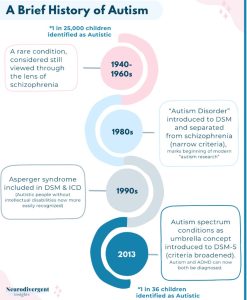
Source for image: https://neurodivergentinsights.com/rise-in-autism-diagnoses/
Though my father had lived his entire childhood and much of his adulthood having Autism, as it is a neurodevelopmental condition people are born with, he was undiagnosed and suffered throughout life from many comorbid mental health issues that ultimately related to his inability to connect socially with others and his tendency to think and behave in rigid, repetitive ways, making it hard for him to adapt to different situations. My father was not diagnosed until his late 40s – after years of visiting mental health professionals. My father has struggled with depression, suicidality, and after his diagnosis of Autism developed a problem with alcohol addiction – but thankfully – after being diagnosed and forming a a good relationship with a psychologist who has counseled him for decades and after establishing care with psychiatry to receive medications to help him – he achieved stability in his 50s and 60s like I had never seen before. As a daughter who deeply loved my father, it was distressing to receive calls from him when younger about his dark depressive thinking including his suicidal thoughts. I am so thankful that him receiving an accurate diagnosis, which knowing him well I 100% agree that my father has Autism, has actually helped him tremendously. He gained self-awareness and grew into accepting himself while also equipping himself as best he can to learn social skills and other more adaptive ways of thinking and behaving. He has more social community now in his 60s than he did for decades when he was younger.
I spent years in adulthood as a habilitation technician working with individuals (children and adults) who had neurodevelopmental disorders like Autism, Cerebral Palsy, etc…and as a psychiatric Physician Associate (PA) have diagnosed individuals with Autism and treated such individuals since 2017. My lifetime experience knowing my father, who is highly intelligent yet has Autism, and for years was mis-diagnosed, and seeing how receiving a proper diagnosis helped him in ways that cannot be over-stated, is a huge reason why I continue to love working with the Autism population and why I am also able to bring such knowledge and expertise to this topic. When I look at persons coming in to see me for an Autism evaluation or they already have Autism and are seeking psychiatric treatment, I look at them through the lens that I would want my father to be seen – as a person, an individual, who happens to have Autism but is not defined solely by it.

My father, just like others who have Autism, is a beautiful person with his own preferences, personality traits, talents, skills, life experiences, dreams and so on – I have so many wonderful memories with him over the years and do not reduce him in my mind as just someone with Autism. Though understanding that he has Autism helps me understand and love him better, I know that not everything about him and not every decision he makes is because of Autism. That being said, at the same time, I do understand that Autism greatly contributes to his experience and without understanding that about him I am missing a big part of who he is. Trust that when you bring yourself or loved ones to Oasis Mental Wellness I apply this same compassionate and understanding lens to anyone who seeks a diagnosis or treatment.
What Causes Autism and How is Autism Diagnosed?
The causes of Autism are complex and multifactorial and at its core it is important to understand that Autism is a neurodevelopmental disorder – meaning that this condition does not develop later in life and the contributing factors occur early in the womb or shortly after birth. For example – it is well known amongst Autism experts that in addition to genetics there is often a history of environmental factors such as pregnancy complications in individuals who have Autism. My father for instance was born small for gestational age and likely experienced fetal growth restriction while developing in my grandmother’s womb and when he was born he almost died as a “blue baby” due to lack of oxygen and needed to spend days in an incubator. This kind of history is not required for a diagnosis of Autism, but it is relatively common for me to hear these kinds of histories when I am evaluating patients for Autism. Other factors associated with Autism include advanced parental age, infection of the mother during pregnancy, etc…

In regards to genetics, there are many genes that have been implicated in research as contributing to Autism such that there is no one gene that causes someone to have Autism. This is known as polygenic inheritance and is partly why Autism is an incredibly heterogenous condition – no two people with Autism are exactly alike.
For those that want to learn more about Autism, consider these resources including educational videos provided by the American Association of Child and Adolescent Psychiatry[i]:

https://www.aacap.org/aacap/Families_and_Youth/Resource_Centers/Autism_Resource_Center/Home.aspx
Research is ongoing in regards to what specific genes and environmental factors contribute to Autism, but what is equally important to understand is what does NOT contribute to Autism.
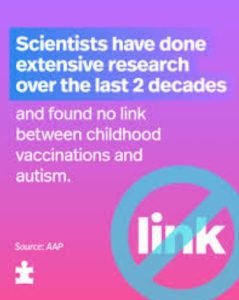
A seminal paper came out in the 1990s claiming that vaccines caused Autism and this contributed to a movement of parents wanting to withhold vaccines from their children, but this poorly researched paper has been debunked resoundingly by the scientific community and the journal that published the paper retracted the paper in 2010 due to problems with data selection, manipulation and undisclosed conflicts of interest[i]. The author claimed that ingredients of the Measles, Mumps and Rubella (MMR) vaccine caused Autism. The author at the time was receiving funding to develop a measles vaccine as an alternative to the MMR vaccine and stood to gain financially should his vaccine be approved. Other claims that thimoseral have also been linked to Autism but this has also been challenged and disproven by the scientific community and at any rate – most childhood vaccines no longer contain Thimoseral.
A diagnosis of Autism requires an evaluation by a trained professional to complete a clinical diagnosis that relies on directly observing the patient and collecting a detailed developmental history. There are various professionals who are qualified to complete these evaluations, including pediatricians, psychologists and psychiatric providers. As part of the evaluation process the professional utilizes standardized criteria through the Diagnostic and Statistical Manual (DSM-5).
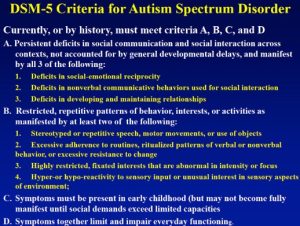
There are three separate criteria for social deficits all of which must be met for a diagnosis and there are 4 criteria related to restricted, repetitive patterns of behaviors, interests or activities of which only 2 criteria of the 4 must be met. It is possible to have sensory processing issues and not have Autism. Diagnosing Autism understands what the whole presentation of the person must look like – and this presentation of symptoms must be evident from a young age.
There are many tools that can be used to aid a professional in making a diagnosis beyond the observations and conversations with the patient and family/caregivers/closed loved ones – such as various questionnaires, standardized tools like the ADOS (Autism Diagnostic Observation Schedule) tools, and other tests. For example, the younger the age of the person being evaluated the more extensive testing needs to be done to rule out other causes of patient’s presentation or other conditions. A very young child will for example typically have a hearing test to rule out a hearing problem contributing to communication deficits, and typically children under teenage years should be evaluated using a standardized tool like ADOS or otherwise complete extensive neuropsychological testing to evaluate Autism as well as cognitive/intellectual domains, so as to diagnose as accurately as possible without missing important comorbid conditions like learning disorders, ADHD, etc….
Lydia Ramos at Oasis Mental Wellness specializes in diagnosing Autism, which most psychiatric providers do not have experience in, and this writer is equipped not just to diagnose Autism for patients under 18 but can diagnose Autism in adults. Given the challenges of accurately diagnosing Autism in adults as these individuals are typically more intelligent and higher-functioning, is why the expertise at Oasis Mental Wellness is a benefit to the surrounding community. For children under age 12-13, depending on the presentation, Lydia Ramos recommends more formal testing through a psychologist in conjunction with her own assessment for the reasons stated above. Lydia Ramos is also an expert of ADHD and can diagnose ADHD clinically in patients of all ages.
What to Understand About the “Autism Registry”
Under the current presidential administration there have been discussions in early 2025 involving Health and Human Services (HHS) and the National Institutes of Health (NIH) about a federal initiative to study environmental factors related to Autism and initial reports used the word “registry” which reasonably provoked confusion and anxiety about patients’ privacy. Although there have been mixed messages/contradictory statements from HHS about the Autism registry, given the unpredictability of the current administration Oasis Mental Wellness will continue to pay attention and wants to offer the following commentary:
Please consider the following and be reassured:
Accountability for privacy: This initiative is being monitored by privacy experts and disability advocates for data security including ways to ensure data that is de-identified cannot be re-identified. Advocates are also pushing for transparency and generally for ethical oversight.
Commitment to Privacy
At Oasis Mental Wellness we want to reassure you of a commitment to protect your privacy, which thankfully is strongly defended by the federal Health Insurance Portability and Accountability Act (HIPAA)[i]. This act sets national standards for protecting your private health information which includes your personally identifiable health information (PHI) along with your medical records. This would therefore include your basic identifying information along with your diagnoses, treatment, etc..
Another concern I have received from patients is whether their PHI can be shared with others, including government agencies for a registry. Please be reassured that as a patient you have control over who receives access to your PHI and this practice cannot release your information without your explicit written consent except for under legally defined circumstances (such as a court order or for public health reporting which requires de-identified data). As a small mental health practice and not a large agency or healthcare organization, it is doubtful that a government agency would take any interest in receiving even de-identified data for the Autism registry.
Finally, at Oasis Mental Wellness this practice adheres to HIPAA requirements for data security safeguards (administrative, physical and technical) to protect your confidentiality and if there is ever a breach in the security of your information, this practice is required by law to notify you of such a breach.
The bottom line is that Oasis Mental Wellness adheres to HIPAA regulations with the utmost seriousness, and even though no one can predict how things will continue to unfold in the future, this writer is confident that a federal program aiming to collect identifiable health data would face significant legal and ethical hurdles under existing privacy laws.
References
[1] The history of Autism. National Autistic Society. Accessed June 9th, 2025. https://www.autism.org.uk/advice-and-guidance/what-is-autism/the-history-of-autism
[2] American Academy of Child and Adolescent Psychiatry. Autism Resource Center. Last updated December 2023. Accessed June 9th, 2025. https://www.aacap.org/aacap/Families_and_Youth/Resource_Centers/Autism_Resource_Center/Home.aspx
[3] Vaccines don’t cause Autism. Why do some people think they do? John Hopkins Bloomberg School of Public Health. Published March 19th, 2025. Accessed June 9th, 2025. https://publichealth.jhu.edu/2025/the-evidence-on-vaccines-and-autism
[4] Office of Civil Rights. Summary of the HIPAA Privacy Rule. U.S. Department of Health and Human Services. Reviewed March 14th, 2025. Accessed June 9th, 2025. https://www.hhs.gov/hipaa/for-professionals/privacy/laws-regulations/index.html
© 2024 Oasis Mental Wellness. All Rights Reserved | Privacy Policy | Site Designed & Maintained by MRN Web Designs