Browsing the Digital Therapeutics (DTx) Landscape for Mental Health
Society has a challenging task to find ways to make mental healthcare more accessible, affordable and equitable for all amidst a growing population with increasing demand for services as more people are becoming open to and seeking mental health treatment in the context of a shortage of mental healthcare providers within a healthcare system where the general trend is rising healthcare costs over time. Technology can be a useful tool to meet some of these needs – but how?
First, what is the definition of “Digital Therapeutics” (DTx) – Digital therapeutics are software-based applications that use evidence-based interventions to help patients prevent, manage or treat medical conditions. DTx can be used alone or in addition to therapies, medications, or devices. DTx allow patients to be more involved with their care and can theoretically lead to better patient outcomes.
The Society for Participatory Medicine is an organization that is focused on participatory medicine as a way to increase access to marginalized communities, improve health outcomes, lower the costs of healthcare and improve patient satisfaction via increased collaboration between patients and providers and digital therapeutics provides a way to achieve this: https://participatorymedicine.org/
What is Evidence-Based?
But there are so many digital tools. Part of the definition of DTx includes the phrase “evidence-based” – how do we differentiate between DTx and other digital tools that are not evidence-based?
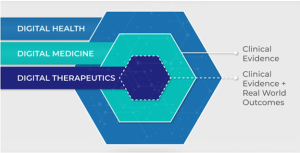
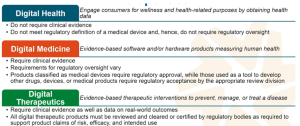
The field is advancing rapidly and so is the terminology, but to break down these terms will help us understand the difference between DTx and other digital tools. Digital health is according to the FDA the use of digital technologies to improve healthcare, patient engagement, and wellness, including the development of those technologies. It is a broad term that includes many things, such as ehealth (web-enabled systems and processes to help with managing patient care), m-health (mobile apps), telehealth, electronic patient records, remote monitoring, connected devices and digital therapeutics. In other words – all DTx are encompassed under the broad term Digital health but not all digital health tools are DTx.
Digital Medicine according to the Digital Medicine Society is a field concerned with the use of technologies as tools for measurement and intervention in the service of human health. Digital medicine is considered to be a subset of human health where the focus is solely on diagnosing, monitoring, and treating diseases. Digital medicine does require clinical evidence.
Digital Therapeutics (DTx) are a further subset of digital medicine that not only require clinical evidence but also require data on real world outcomes.
All digital medicine products can be FDA approved or direct-to-consumer.
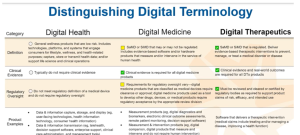
Reviewing the Digital Terminology
An example of Digital Health that many people are familiar with is the Calm App.
For further help in distinguishing between these terms:
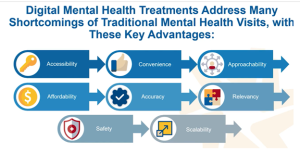
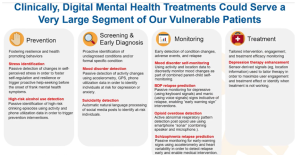
Consider that digital mental health treatments offer the following:
How are Digital Therapeutics Developed?
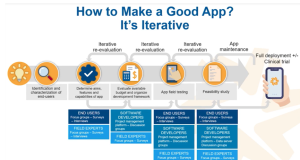
We have now defined what DTx are. How are DTx developed?
This will help us understand the current products available and the pipeline of future DTx.
The Federal Trade Commission is now largely overseeing the development of apps as DTx as the FDA got rid of its emergency authorization use to pre-certify DTx . The FTC released a tool to app developers to help them in the process as they navigate how to create apps that take into account ethical considerations and regulatory requirements . Remember though that DTx require clinical evidence and data on real world outcomes. DTx can seek FDA approval to be prescribed by clinicians – otherwise, if DTx are not FDA-approved then they are considered to be “OTC” (Over the counter).
What About Mental Health?
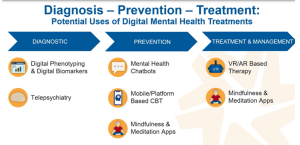
How can DTx be used specifically in the realm of mental health?
Reference: 8 (see footnotes)
Reference: 9 (see footnotes)
Where to Look for DTx?
Now, are we ready to explore the landscape of DTx? Consider these resources before we go to specific examples:
MINDapps.org is a searchable database of apps – https://mindapps.org/
PsyberGuide is another good database for apps – https://onemind.org/psyberguide/
A good e.g. of what some institutions are doing with mobile apps includes the VA App Store (https://mobile.va.gov/) and Kaiser Permanente (https://healthy.kaiserpermanente.org/pages/mobile-app)
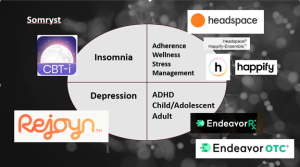
Here are some examples of DTx apps worth knowing about:
Looking at the above from left to right:
Somryst – This is the first FDA approved prescription digital therapeutic for chronic insomnia that includes a comprehensive suite of tools for treating insomnia – https://www.somryst.com/
CBT-i – This is a free and publicly available app that provides CBT-Insomnia, an evidence-based, first-line treatment for insomnia
Headspace – This app requires a subscription and provides +500 meditations on everything from stress, resilience, compassion and more; meditations are tailored for sleep, waking up, movement, and for focusing the mind; 40% of studies show improvements in mindfulness, well-being, stress and anxiety
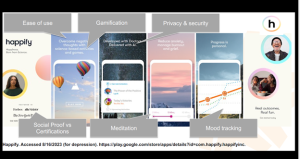
Happify – Provides effective tools to combat negative thoughts and transform them into positive thoughts – techniques in the app (engaging activities and games) combine evidence-based strategies from mindfulness, positive psychology and CBT
Endeavor Rx and Endeavor OTC – Endeavor Rx is the first FDA-approved digital therapeutic for kids with ADHD (ages 8-17) – it is basically a video game with sensory stimuli and motor challenges to target attentional functioning and has an evidence based from multicenter Randomized Controlled Trials (RCT); Endeavor OTC is an OTC product (with FDA approval) for adults that requires a subscription but utilizes the same evidence-based approach as Endeavor Rx
Before I describe Rejoyn in more detail I want to include this within a section looking at depression, which globally is one of the major causes of disability.
Depression – What Causes It?
I wanted to highlight the topic of depression because of the sheer magnitude of impact of this disorder. An estimated 21 million U.S. adults suffered from a Major Depressive Episode in 2021, which amounts to about 8.3% of the population. Out of these 21 million individuals, about 14.5 million suffered severe impairment with daily functioning and quality of life affected.
Suicide rates have risen dramatically in recent decades, even recent years, and depression is a leading contributor to suicide – increasing the risk of suicide by 20X .
On top of this, 1 in 3 adults in the U.S. with MDD do not receive treatment and 40-60% do not respond to the first-line treatment of an antidepressant. Longer depressive episodes may decrease chance of remission and increase risk of reoccurrence .
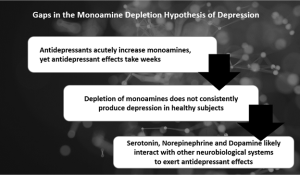
A common misperception as to how antidepressants work is that they modulate neurotransmitter activity (Serotonin, Norepinephrine, Dopamine). This is not actually how they work. Several clues that point away from a monoamine theory of depression are:
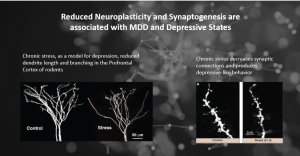
The reason we think antidepressants and other treatments for depression work has to do with neuroplasticity – which is the brain’s ability to reorganize its structure, functions and connections in response to internal or external stimuli. We can see changes on a structural level such as an increased density of dendritic spines and on a functional level such as for e.g. an increased firing rate between specific neurons in a particular circuit or a change in how firing is occurring (synchronous vs. asynchronous).
Apps for Depression –
Current and Emerging
Cognitive Behavioral Therapy (CBT) is a 1st-line treatment for depression, and is typically administered by psychotherapists. Its premise is that thoughts are connected to feelings and behaviors and that we can target maladaptive thoughts and behaviors as a way to combat depression. Issues with this though include scale and affordability.
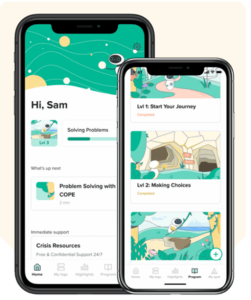
Spark Rx is a prescription digital therapeutic designed by Limbix to provide psychoeducation, self-guided CBT, quick help for crises, to teens and young adults from ages 13-22. Limbix was acquired by Big Health and the app has been renamed to Spark Direct. This product also offers Daylight for anxiety and Sleepio for insomnia.
Accessed on https://www.bighealth.com/spark-direct on August 3rd, 2024.
The Happify app was already mentioned above and actually has shown to be beneficial for depression:
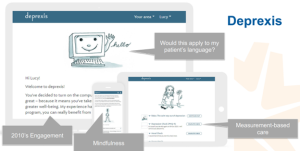
Deprexis is a web application indicated for the adjunctive treatment of chronic or
recurrent depression or depressive disorders for patients 18 years and older:
Accessed on https://www.ethypharm-digital-therapy.com/our-digital-therapies/deprexis/.
Deprexis is a 12-week online program that uses proven counseling techniques to improve people’s thoughts and behaviors, without having to connect to a live person.
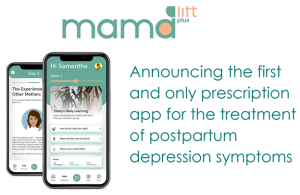
Mama Lift Plus is a FDA-approved prescription-based app for postpartum depression and anxiety.
Program is 8 weeks. The prescribed app leverages proprietary algorithms and personalized digital behavioral interventions to facilitate the timely identification of which patients need intervention support and treatment. Per study claims, MamaLift Plus connects patients to appropriate intervention diverting approximately 2 out of 3 cases that would have developed into severe depression.
The interventions and treatment provide bite-sized daily lessons based on Cognitive Behavioral Therapy (CBT) and Interpersonal Therapy (IPT), on-demand, self-paced lessons developed by experts, the ability to uncover trends & gain actionable insights on mood, activity, sleep, health vitals tracking, and includes live health coaches & therapists. Coaches are typically social workers or other public health professionals. All coaches have prior clinical experience and a master’s degree or greater and training in maternal mental health, and principles of coaching, and they perform a series of “mock” sessions. Coaches also experience the program as a patient would. Patients can choose to meet virtually with a health coach or engage via ongoing asynchronous chat.
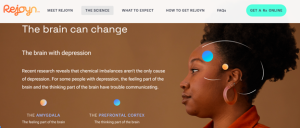
Finally, Rejoyn is a prescription digital therapeutic for the treatment of Major Depressive Disorder (MDD) as an adjunct to clinician-managed care for adults 22+ who are on antidepressant medication, and it is the first FDA-approved DTx for depression. Clinical trials showed that use of Rejoyn reduced depressive symptoms by using cognitive-emotional training using working memory tasks, identification of emotions, and CBT-based video lessons, and that these improvements were also seen in patients with moderate to severe anxiety symptoms.
Accessed on https://www.rejoyn.com/ on November 1st, 2024.
Choosing the Good App from the Bad Ones
You may say thanks for the review, but how do I select a mental health app on my own and know that it is a good app?
The American Psychiatric Association (APA) has an App Evaluation Model that I think is useful to consider and can be found on the following website:
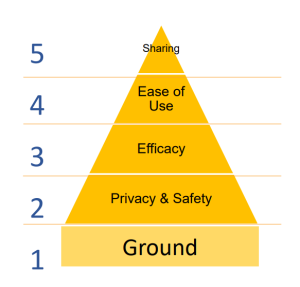
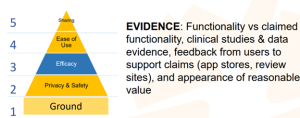
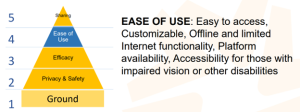
Following this model, we evaluate each app from 1 to 5:
The first step is a review of the basics (access and background) so you can decide if it is worth it to proceed with the rest of your review. Questions you would ask for Step 1 review include:
• Does the app identify ownership? • Does the app identify funding sources and conflict of interest? • Does the app come from a trusted source? • Does it claim to be medical? • Are there additional or hidden costs? • Does the app work offline? • On which platforms/operating systems does it work? • When was the app last updated?
Step 2 reviews Privacy and Security by asking the following questions:
• Is there a transparent privacy policy that is clear and accessible before use? • Does the app declare data use and purpose? • Does the app describe the use of Patient Health Information? Is the information deidentified vs. anonymous? • Can you opt out of data collection or delete data? • Are data maintained in the device or on the web? • Does the app explain security systems used? • Does the app collect, use or transmit sensitive data? If yes, does it claim to do so securely? • What third parties does the app share data with? • If appropriate, is the app equipped to respond to certain harms or safety concerns?
Step 3 looks at the clinical evidence:
You can ask the following questions for this step:
• Does the app appear to do what it claims to do? • Is the app content correct, well-written, and relevant? • What are the relevant sources or references supporting the app use cases? • Is there evidence of specific benefit from academic institutions, publications, end user feedback, or research studies? • Is there evidence of effectiveness/efficacy? • Was there an attempt to validate app usability and feasibility?
Step 4 looks at usability:
Step 5, the final step, looks at the app’s ability to share data, such as with electronic health records; can the data be printed, exported or downloaded; can data be shared with other data user tools like Apple HealthKit, Google Fit.
I appreciate you coming on this journey with me to better understand digital mental health treatments and hope this was informing and helpful! Please consider booking an appointment at Oasis Mental Wellness, PLLC for your psychiatric services to get holistic care from an expert clinician.
References:
1. U.S. Food and Drug Administration staff. What is Digital Health? Digital Health Center of Excellence. September 22nd, 2020. Accessed July 23rd, 2024. (https://www.fda.gov/medical-devices/digital-health-center-excellence/what-digital-health) 2. Digital Medicine Society staff. Defining Digital Medicine. Digital Medicine Society. Accessed July 23rd, 2024. (https://dimesociety.org/about-us/defining-digital-medicine/) 3. Dang A, et al. Family Med Prim Care. 2020;9(5):2207-2213. Goldsack J, et al. Digital Health, Digital Medicine, Digital Therapeutics (DTx): What’s the difference? November 10, 2019. Accessed July 2024. (https://dimesociety.org/digital-health-digital-medicine-digital-therapeutics-dtx-whats-the-difference/) 4. Goldsack J, et al. Digital Health, Digital Medicine, Digital Therapeutics (DTx): What’s the difference? November 10, 2019. Accessed July 2024. (https://dimesociety.org/digital-health-digital-medicine-digital-therapeutics-dtx-whats-the-difference/) US food and Drug Administration. What is Digital Health? September 22, 2020. Accessed July 23rd, 2024. (www.fda.gov/medical-devices/digital-health-center-excellence/what-digital-health). Chan SR, et al. Privacy and Security for Psychiatry Health IT. In: APA Publishing Textbook of Administrative Psychiatry. 2022. 5. Biaganti B, et al. Evid Based Mental Health. 2017;20(4):98-101. 6. Federal Trade Commission staff. FTC releases new guidance for developers of mobile health apps – tool created in conjunction with HHS and FDA will help business determine applicable laws and regulations. April 5th, 2016. Accessed July 25th, 2024. (https://www.ftc.gov/news-events/news/press-releases/2016/04/ftc-releases-new-guidance-developers-mobile-health-apps) 7. Federal Trade Commission staff. Mobile Health App Interactive Tool. July 2024. Accessed July 28th, 2024. (https://www.ftc.gov/business-guidance/resources/mobile-health-apps-interactive-tool) 8. Huckvale K, et al. NPJ Digit Med. 2019;2:88. 9. Phelan H. Digital Mental Health – Targeting the Epicenter. February 7, 2020. Accessed July 28th, 2024. (www.healthxt.com/blog/digital-mental-health-targeting-the-epicenter) 10. National Institute of Mental Health (NIMH). Major Depression. (n.d.). Accessed July 28th, 2024. (https://www.nimh.nih.gov/health/statistics/major-depression). Greenberg PE et al. Pharmacoeconomics. 2021;39(6):653-665. 11. Borentain S, et al. BMC Psychiatry. 2020;20(1):384. Centers for Disease Control and Prevention. Suicide data and statistics. Accessed July 29th, 2024. (https://www.cdc.gov/suicide/suicide-data/statistics.html) 12. Hasin DS et al. JAMA Psychiatry. 2018 Apr 1;75(4):336-346. Mongelli F, et al. Focus (Am PsychiatrPubl). 2020;18(1):16-24. Ofenedu ME, et al. J Child Fam Stud. 2017;26(3):863-876. Marasine NR, et al. Turk J Pharm Sci. 2021;18(2):242-249. MacQueen G, et al. Can J Psychiatry. 2017;62(1):11-23. Rush AJ, et al. Am J Psychiatry. 2006;163(11):1905-1917. Lye MS, et al. PLoS One. 2020;15(3):e0230363. Mauskopf JA, et al. Depress Anxiety. 2009;26(1):83-97. 13. Boku S, et al. Psychiatry Clin Neurosci. 2019;13:66. Dean J, et al. Asian J Psychiatr. 2017;27:101-111. Tartt AN et al. Mol Psychiatry. 2022;27(6):2689-2699. Benett SH, et al. Neurosci Biobehav Rev. 2018;88:51-62. 14. Duman RS, et al. Science. 2012;338(6103):68-72.